
In-Depth Guide to Understanding Middleware
Middleware is a crucial concept in web development, acting as the bridge between the client and server. This post explores the role of middleware in handling requests and responses, enhancing functionality, and improving security. We'll delve into various types of middleware, including logging, authentication, error handling, and more, with practical examples and best practices to help you integrate middleware effectively into your web applications.
EXPRESS JSFULL STACK DEVELOPMENT
Abhay Kumar
5/19/20247 min read


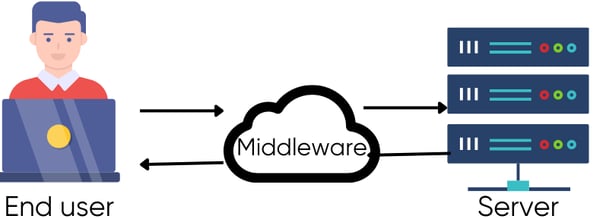
Middleware in the context of Express JS (and web frameworks in general) refers to functions that have access to the request object (req), the response object (res), and the next middleware function in the application’s request-response cycle.
These functions can perform a variety of tasks before passing control to the next middleware function, making them an essential part of handling HTTP requests in a web server.
Key Characteristics of Middleware
Access to Request and Response Objects
Control Flow
Chaining
Middleware
simple Middleware are just functions that receive three arguments:
req the request object, more on this later
res the response object, more on this later
next a function that passes the req/res objects to the next middleware or route.
error handling Middleware are just functions that receive four arguments:
err the err object, for error handling
req the request object, more on this later
res the response object, more on this later
next a function that passes the req/res objects to the next middleware or route.


Types of Middleware in Express JS.
Types Of Middleware
Application-Level Middleware
Router-Level Middleware
Error-Handling Middleware
Built-in Middleware
Third-Party Middleware


Application-Level Middleware
Application-level middleware is bound to an instance of the express application object using app.use() or app.METHOD() where METHOD is one of the HTTP methods (e.g., GET, POST).
Router-Level Middleware
Router-level middleware works the same way as application-level middleware except it is bound to an instance of express.Router().




Error-Handling Middleware
Error-handling middleware is defined with four arguments: (err, req, res, next). Express identifies it as an error-handling middleware function.
Built-in Middleware
Express comes with several built-in middleware functions that handle common tasks.
Examples:
express.static(): Serves static files.
express.json(): Parses incoming requests with JSON payloads.
express.urlencoded(): Parses incoming requests with URL-encoded payloads.


Third-Party Middleware
Third-party middleware is created by the community and can be added to your Express app to handle various tasks. These are available as npm packages.
Examples:
morgan: HTTP request logger middleware.
helmet: Helps secure Express apps by setting various HTTP headers.
cors: Enables Cross-Origin Resource Sharing.


Few Method Where Middleware is used
Application Level :- use middleware methods
app.use([path,] middlewareFunction [, middlewareFunction...]) :-
Uses the specified middleware function all/specified path.
defaults path :- “/”
Uses the specified middleware functions at the specified path:
the middleware function is executed when the base of the requested path matches path.
path :- The path for which the middleware function is invoked; can be any of:
A string representing a path.
A path pattern.
A regular expression pattern to match paths.
An array of combinations of any of the above.
middlewareFunction :- middlewareFunction functions; can be:
A middleware function.
A series of middleware functions (separated by commas).
An array of middleware functions.
A combination of all of the above.
Router Level :- use middleware methods
router.use([path,] middlewareFunction [, middlewareFunction...]) :-
Uses the specified middleware function all/specified path.
defaults path :- “/”
Uses the specified middleware functions at the specified path:
the middleware function is executed when the base of the requested path matches path.
path :- The path for which the middleware function is invoked; can be any of:
A string representing a path.
A path pattern.
A regular expression pattern to match paths.
An array of combinations of any of the above.
middlewareFunction :- middlewareFunction functions; can be:
A middleware function.
A series of middleware functions (separated by commas).
An array of middleware functions.
A combination of all of the above.
Router Level :- routing methods :- wtih use of middleware function method
Routing Methods :-
checkout , copy , delete , get , head , lock , merge , mkactivity
mkcol , move , m-search , notify , options , patch , post
purge , put , report , search , subscribe , trace , unlock , unsubscribe
router.METHOD(path, [middlewareFunction, ...] middlewareFunction) :-
Routes an HTTP request,
where METHOD is the HTTP method of the request,
such as GET, PUT, POST, and so on, in lowercase.
Thus, the actual methods are router.get(), router.post(), router.put(), and so on
router.all(path, [middlewareFunction, ...] middlewareFunction) :- the standard router.METHOD() methods, except it matches all HTTP verbs
router.get(path, middlewareFunction [, middlewareFunction ...]) :- Routes HTTP GET requests
to the specified path with the specified middleware functions.
router.post(path, middlewareFunction [, middlewareFunction ...]) :- Routes HTTP POST requests
to the specified path with the specified middleware functions.
router.put(path, middlewareFunction [, middlewareFunction ...]) :- Routes HTTP PUT requests
to the specified path with the specified middleware functions.
router.delete(path, middlewareFunction [, middlewareFunction ...]) :- Routes HTTP DELETE requests
to the specified path with the specified middleware functions.
router.route(path) :- Returns an instance of a single route, which you can then use to handle HTTP verbs with optional middleware.
Use router.route() to avoid duplicate route names (and thus typo errors)
router.route(path).method1(mw [, mw ...]).method2(mw [, mw ...]).method3(mw [, mw ...]).....methodN(mw [, mw ...])
ex:- router.route(path).get(mw [, mw ...]).post(mw [, mw ...]).put(mw [, mw ...])
Application Level : - routing methods :- wtih use of middleware function method
Routing Methods :-
checkout , copy , delete , get , head , lock , merge , mkactivity
mkcol , move , m-search , notify , options , patch , post
purge , put , report , search , subscribe , trace , unlock , unsubscribe
app.METHOD(path, middlewareFunction [, middlewareFunction ...]) :-
Routes an HTTP request,
where METHOD is the HTTP method of the request,
such as GET, PUT, POST, and so on, in lowercase.
Thus, the actual methods are app.get(), app.post(), app.put(), and so on
app.all(path, middlewareFunction [, middlewareFunction ...]) :- the standard app.METHOD() methods, except it matches all HTTP verbs
app.get(path, middlewareFunction [, middlewareFunction ...]) :- Routes HTTP GET requests
to the specified path with the specified middleware functions.
app.post(path, middlewareFunction [, middlewareFunction ...]) :- Routes HTTP POST requests
to the specified path with the specified middleware functions.
app.put(path, middlewareFunction [, middlewareFunction ...]) :- Routes HTTP PUT requests
to the specified path with the specified middleware functions.
app.delete(path, middlewareFunction [, middlewareFunction ...]) :- Routes HTTP DELETE requests
to the specified path with the specified middleware functions.
app.route(path) :- Returns an instance of a single route, which you can then use to handle HTTP verbs with optional middleware.
Use app.route() to avoid duplicate route names (and thus typo errors)
app.route(path).method1(mw [, mw ...]).method2(mw [, mw ...]).method3(mw [, mw ...]).....methodN(mw [, mw ...])
ex:- app.route(path).get(mw [, mw ...]).post(mw [, mw ...]).put(mw [, mw ...])
Few Use & Example Of Middleware
Application Level :- Single middleware :- with Error-handling
router level :- Single middleware :- with Error-handling
middleWare without error handling without next
middleWare without error handling with next
middleWare with error handling without next
middleWare with error handling with next
routerHandler also consider as middleWare.
Application Level :- with routerHandler which is without error handling without next
router level :- with routerHandler which is without error handling without next
Application Level :- with routerHandler which is without error handling with next
router level :- with routerHandler which is without error handling with next
Application Level :- with routerHandler which is with error handling without next
router level :- with routerHandler which is with error handling without next
Application Level :- with routerHandler which is with error handling with next
router level :- with routerHandler which is with error handling with next
Application Level :- :- with get, post , put , delete :- with routerHandler which is with error handling with next
router level :- :- with get, post , put , delete :- with routerHandler which is with error handling with next
Application Level :- :- routerHandler and multiple middleWare :- which is without error handling with next
router level :- :- routerHandler and multiple middleWare :- which is without error handling with next
Application Level :- :- routerHandler and multiple middleWare :- which is with error handling with next
router level :- :- routerHandler and multiple middleWare :- which is with error handling with next
in using of multiple routerHandler / middleWare
:- which don't call next() (ex:- mw00 , mw01 , mw02 , mw03 , mw13 , mw14 , mw15 , mw16)
:- use that middleWare at last
:- because if first middleWare don't call next() then we can't move on second middleWare
:- next() :- it helps to call next routerHandler/middleWare/function
:- any middleWare call next() then we can move on next middleWare
if you want to make middleWare then create middleWare with error handling with next
because it gives you option to call error, request response and next method
if you next method require then call otherwise don't call
Application Level :- with :- routerHandler and multiple middleWare :- which is with error handling with next
last middleWare/routerHandler is with error handling without next
router level :- with :- routerHandler and multiple middleWare :- which is with error handling with next
last middleWare/routerHandler is with error handling without next
Application Level :- with :- routerHandler and multiple middleWare :- which is with error handling with next
last middleWare/routerHandler is without error handling without next
router level :- with :- routerHandler and multiple middleWare :- which is with error handling with next
last middleWare/routerHandler is without error handling without next